Pearl grading you can verify, not just believe
Most online pearl sellers now say it openly: their letter grades are their own invention, and no outside authority stands behind them. We take a different position. Our grades are calibrated to an outside benchmark, our top strands carry independent laboratory reports, and we invite you to test our pearls side by side against the most respected name in Akoya.
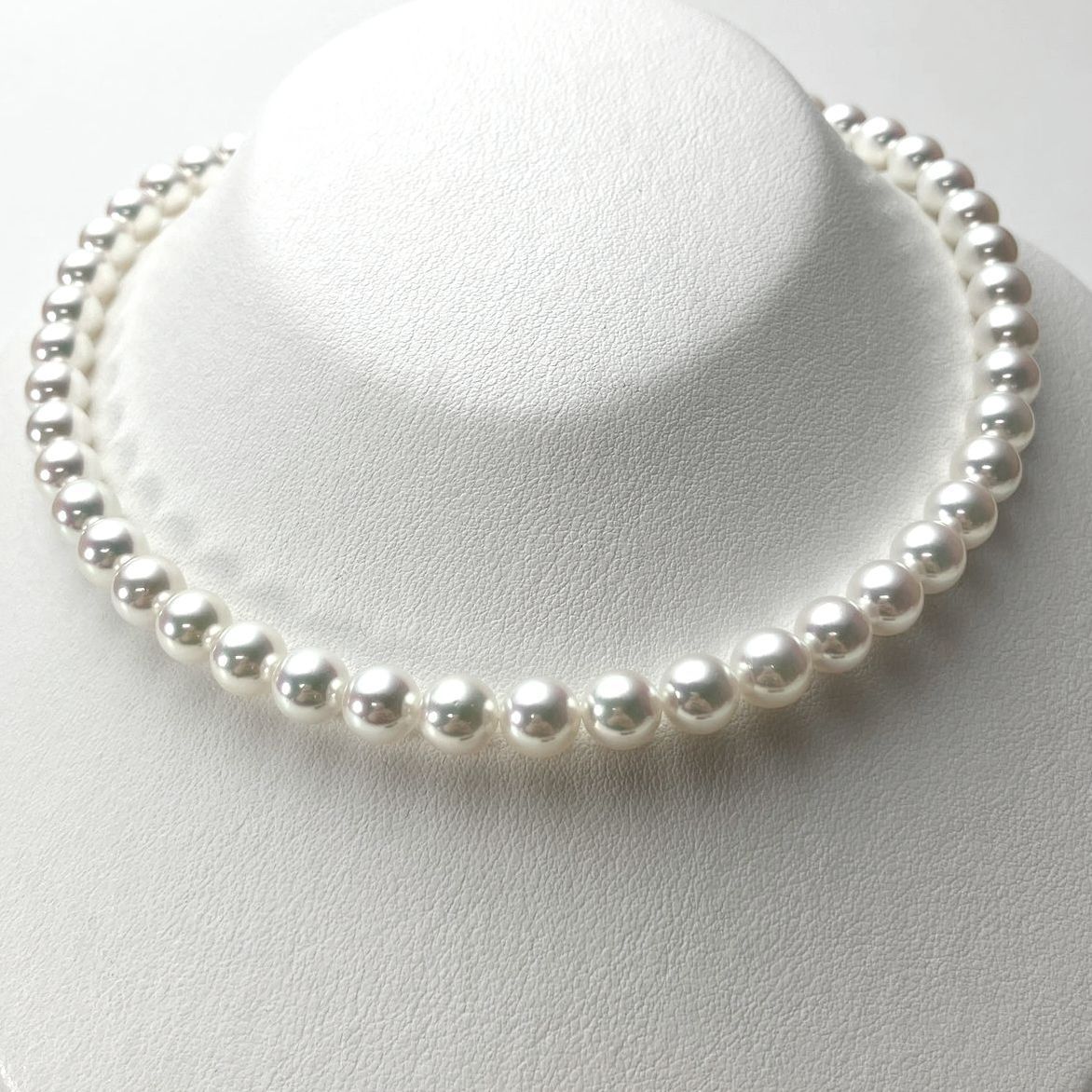
A grade invented by the seller can only tell you what the seller thinks. A grade tied to an outside standard tells you where the pearls actually rank.
That difference is the whole point of this page. Below you'll find the scale we use, the benchmark it is calibrated against, the laboratories that confirm our best strands, and a simple test you can run at home, on our pearls or anyone else's.
Two ways to grade a pearl
Every seller makes the same basic choice. Either it writes its own scale and asks you to trust it, or it anchors its scale to something outside its own walls that you can check.
| A self-defined house scale | The American Pearl standard | |
|---|---|---|
| Who sets the scale | The seller writes it and applies it to its own inventory. | Our master strands are indexed to the original A–AAA standard, matched side by side and confirmed with laboratory testing. |
| How fine the scale is | Usually three or four letter grades, with surface given as percentages that no instrument measures. | Eight steps for Akoya, from A1 to True AAA, each with a stated luster level and a stated surface level. |
| Fit to the pearl type | One letter system stretched across every pearl type. | A separate scale for each pearl type: eight steps for Akoya, where luster varies most, and four for Tahitian, South Sea and freshwater, each built around what actually separates one pearl from the next. |
| Paperwork | A lab report on a small number of top strands; everything else rests on the seller's word. | A GIA or Pearl Science Laboratory report on each of our certified strands, and an Evaluation & Identification Report available on any True AAA strand. |
| What happens if you disagree | A return window. | A 90-day money-back guarantee on Japanese Akoya necklaces, plus a written promise: compare our strand with an equivalently graded strand from the most respected names in Akoya, and ours will be of equal or greater quality. |
| Where the pearls come from | Bought at market, in competition with every other buyer. | Seventy-five years of relationships with the same farmers, who set aside the top of the harvest for us before it reaches market. |
The benchmark behind our letters
The A, A+, AA and AAA grading of Akoya pearls goes back to Mikimoto, whose gemologists developed the first widely recognized system for the category. It's the yardstick most of the trade still measures against, even sellers who now write their own definitions.
Our clients have been putting that to the test for decades. Many compare our strands side by side with the great pearl houses before they buy, and for more than twenty years they've written to tell us what they found. Read their letters in our customer testimonials.
We didn't write a new yardstick. Our GIA-trained gemologists reference master strands and their experience that have been indexed to that original standard, compared side by side and confirmed by laboratory testing. Every Akoya strand we sell is graded against those masters. So when we call a strand AA, the word has the same meaning it has at the counter of the most expensive pearl house in the world.
That's why we can make a promise that a self-graded seller can't: put our strand next to an equivalently graded strand from any of the great pearl houses, and ours will be of equal or greater quality. If it isn't, return it. Japanese Akoya necklaces carry a 90-day money-back guarantee.
Our grades, step by step
Choose a pearl type. Each one has its own scale. Every grade states its luster and surface, plus shape, matching and nacre, so you know exactly what you're paying for.
You may also see pearls sorted A, B, C and D. That is a wholesale trade scale, and we discuss it only for education, on our Tahitian & South Sea grading guide. Every pearl on our website is graded on the scales below.
| Grade | Luster | Surface | Shape* | Matching | Nacre | Paperwork |
|---|---|---|---|---|---|---|
| True AAA | Exceptional, mirror-like reflection | Very clean | Closely conforms to stated shape | Excellent | Very good | Evaluation & Identification Report available, GIA grading system |
| AAA1 | Minimally blemished | |||||
| AA | Superb, clear reflection | Very slightly blemished | Closely conforms to stated shape | Very good | Very good | Graded against our master strands |
| AA1 | Slightly blemished | |||||
| A+ | Very good, clear reflection | Very slightly blemished | Closely conforms to stated shape | Good | Good | |
| A+1 | Slightly blemished | |||||
| A | Good, clear reflection | Very slightly blemished | Closely conforms to stated shape | Good | Good | |
| A1 | Slightly blemished |
* Shape is judged against the shape stated for each piece: round, near-round, oval, drop, button, baroque and others. Shape describes a pearl; it doesn't set its quality. A drop-shaped South Sea pearl in a pearl and diamond earring, for example, can be True AAA when its luster, surface and matching meet that grade. "Closely conforms to stated shape" means each pearl is a true, well-formed example of its shape, and the pearls in a strand or pair match one another.
The "1" after a grade means the luster is the same, but the surface sits one step lower. You get two separate pieces of information, not one blended letter. That's how you find the strand where your money buys the most visible beauty.
Collection Quality pearls are hand-picked from our finest strands, the very best of our best pearls, selected for the brightest luster and the closest match from pearl to pearl. Collection Quality strands can be ordered with American Pearl's Signature Figure Eight Clasp. Shop Collection Quality
Tahitian pearls are cultured in the black-lip oyster in Tahiti and French Polynesia. Their dark colors are natural, from silver and charcoal to peacock and green, and color is a matter of taste, so we describe it separately from the grade. The grade tells you about luster and surface.
| Grade | Luster | Surface | Shape* | Matching | Nacre | Paperwork |
|---|---|---|---|---|---|---|
| True AAA | Exceptional, mirror-like reflection | Very Clean | Closely conforms to stated shape | Very good | Excellent | Evaluation & Identification Report available, GIA grading system |
| AAA/AA | Exceptional, mirror-like reflection | A mix of very clean and very slightly blemished pearls | Closely conforms to stated shape | Very good | Excellent | Graded against our master strands |
| AA | Superb, clear reflection | Very Slightly Blemished | Closely conforms to stated shape | Very good | Very good | |
| A+ | Very good, clear reflection | Very Slightly Blemished | Closely conforms to stated shape | Good | Very good | |
| A | Good, clear reflection | Very Slightly Blemished | Closely conforms to stated shape | Good | Good |
* Shape is judged against the shape stated for each piece: round, near-round, oval, drop, button, baroque and others. Shape describes a pearl; it doesn't set its quality. A drop-shaped South Sea pearl in a pearl and diamond earring, for example, can be True AAA when its luster, surface and matching meet that grade. "Closely conforms to stated shape" means each pearl is a true, well-formed example of its shape, and the pearls in a strand or pair match one another.
Golden South Sea pearls are cultured in the gold-lip oyster in the South Sea. Their warm color is natural, and the depth of that gold is described separately from the grade. Because they grow large and carry thick nacre, what most separates one from the next is the surface.
| Grade | Luster | Surface | Shape* | Matching | Nacre | Paperwork |
|---|---|---|---|---|---|---|
| True AAA | Exceptional, mirror-like reflection | Very Clean | Closely conforms to stated shape | Very good | Excellent | Evaluation & Identification Report available, GIA grading system |
| AAA/AA | Exceptional, mirror-like reflection | A mix of very clean and very slightly blemished pearls | Closely conforms to stated shape | Very good | Excellent | Graded against our master strands |
| AA | Superb, clear reflection | Very Slightly Blemished | Closely conforms to stated shape | Very good | Excellent | |
| A+ | Very good, clear reflection | Very Slightly Blemished | Closely conforms to stated shape | Good | Very good | |
| A | Good, clear reflection | Very Slightly Blemished | Closely conforms to stated shape | Good | Very good |
* Shape is judged against the shape stated for each piece: round, near-round, oval, drop, button, baroque and others. Shape describes a pearl; it doesn't set its quality. A drop-shaped South Sea pearl in a pearl and diamond earring, for example, can be True AAA when its luster, surface and matching meet that grade. "Closely conforms to stated shape" means each pearl is a true, well-formed example of its shape, and the pearls in a strand or pair match one another.
White South Sea pearls are the largest cultured pearls, grown in the silver-lip oyster off Australia. Thick nacre gives them a soft, satiny glow and very consistent luster, so the surface is what separates one strand from the next.
| Grade | Luster | Surface | Shape* | Matching | Nacre | Paperwork |
|---|---|---|---|---|---|---|
| True AAA | Exceptional, mirror-like reflection | Very Clean | Closely conforms to stated shape | Very good | Excellent | Evaluation & Identification Report available, GIA grading system |
| AAA/AA | Exceptional, mirror-like reflection | A mix of very clean and very slightly blemished pearls | Closely conforms to stated shape | Very good | Excellent | Graded against our master strands |
| AA | Superb, clear reflection | Very Slightly Blemished | Closely conforms to stated shape | Very good | Excellent | |
| A+ | Very good, clear reflection | Very Slightly Blemished | Closely conforms to stated shape | Good | Very good | |
| A | Good, clear reflection | Very Slightly Blemished | Closely conforms to stated shape | Good | Very good |
* Shape is judged against the shape stated for each piece: round, near-round, oval, drop, button, baroque and others. Shape describes a pearl; it doesn't set its quality. A drop-shaped South Sea pearl in a pearl and diamond earring, for example, can be True AAA when its luster, surface and matching meet that grade. "Closely conforms to stated shape" means each pearl is a true, well-formed example of its shape, and the pearls in a strand or pair match one another.
Our GIA-certified White South Sea strands carry their own laboratory report. Shop White South Sea pearls
Freshwater pearls are cultured in freshwater lakes and rivers. They come in a wide range of shapes and soft natural colors, and they are graded on the same luster-and-surface logic as every other pearl we sell. A freshwater strand doesn't need a made-up brand name to be judged fairly. It needs the same yardstick as everything else.
| Grade | Luster | Surface | Shape* | Matching | Nacre | Paperwork |
|---|---|---|---|---|---|---|
| True AAA | Exceptional, mirror-like reflection | Very Clean | Closely conforms to stated shape | Excellent | Excellent | Evaluation & Identification Report available, GIA grading system |
| AA | Superb, clear reflection | Very Slightly Blemished | Closely conforms to stated shape | Very good | Very good | Graded against our master strands |
| A+ | Very good, clear reflection | Very Slightly Blemished | Closely conforms to stated shape | Good | Good | |
| A | Good, clear reflection | Very Slightly Blemished | Closely conforms to stated shape | Good | Fair |
* Shape is judged against the shape stated for each piece: round, near-round, oval, drop, button, baroque and others. Shape describes a pearl; it doesn't set its quality. A drop-shaped South Sea pearl in a pearl and diamond earring, for example, can be True AAA when its luster, surface and matching meet that grade. "Closely conforms to stated shape" means each pearl is a true, well-formed example of its shape, and the pearls in a strand or pair match one another.
Our True AAA freshwater strands are available with the same Evaluation & Identification Report we provide for True AAA saltwater pearls. Shop Freshwater pearls
Why we don't put percentages on surface
You'll see grades elsewhere described as "95% clean" or "85–95% clean." They look precise. They aren't measurements.
What a surface percentage can't tell you
- No instrument measures it. There's no standard method or device for calculating the percentage of a pearl's surface that is clean. The number is a grader's visual estimate, written as a figure.
- It doesn't say what it's a percentage of. 95% of each pearl's surface? Or 95% of the pearls on the strand? Those are very different strands.
- Part of every pearl is hidden. The surface around the drill holes and against neighboring pearls can't be seen on a finished strand, so nobody sees 100% of it to calculate from.
- The leading laboratory doesn't do it either. GIA classifies surface in descriptive bands (clean, lightly spotted, moderately spotted, heavily spotted), not percentages.
What we do instead
- Honest descriptions. Our surface grades are a trained gemologist's judgment, and we present them as exactly that, in similar descriptive language GIA uses.
- A fixed reference. Every strand is judged against the same master strands, so "very slightly blemished" means the same thing on every strand we sell.
- Real numbers where science gives them. Nacre thickness can be measured by X-ray, and luster can be measured by instrument. Where those figures exist, they come from GIA and Pearl Science Laboratory reports, not from us.
- Your own eyes. Hold the strand in your light and compare it with any other. A grade that survives a side-by-side comparison means more than a percentage no one can check.
A number creates the impression of science. We'd rather tell you plainly which parts of grading are judgment and which parts are measurement, and give you laboratory reports for the parts that can be measured.
Independent laboratories, not house designations
The strongest grade is one the seller didn't assign. Here's where outside parties confirm our pearls.
GIA
The Gemological Institute of America is the most respected non-profit gemological institute in the world. It classifies cultured pearls on seven value factors: size, shape, color, luster, surface, nacre and matching. Our GIA-certified Akoya and South Sea strands each come with their own report. See a GIA report explained, line by line.
Pearl Science Laboratory (PSL)
Japan's Pearl Science Laboratory (PSL) certifies top-quality white Akoya against published criteria and issues a numbered report. We offer PSL-certified strands alongside our GIA-certified strands, so you can choose the laboratory whose report you prefer. See a PSL report explained, box by box.
Our report, on GIA terms
Every True AAA strand is available with an American Pearl Evaluation & Identification Report. It records luster, body color, shape, surface, kind, size and matching in GIA grading-system language, so any independent appraiser can read it and check it. About our reports.
Why our pearls start ahead
Family-owned in New York's Diamond District for three generations. Our parent company is an approved supplier to some of the world's most prestigious jewelry houses, and they hold pearls to the strictest standard in the trade.
Our farmers have sold to us through good markets and bad for decades. In return, they set aside the top of the harvest for American Pearl before the rest is offered to market.
We sell without the retail markup, which is typically three times wholesale or more. Equal-or-better quality to the big-name houses, at a fraction of their price.
Don't take our word for it. Check.
Any grade, ours included, is only worth what the pearls show you. Here's how to judge any strand from any seller.
At arm's length, in daylight
- Luster: look for a sharp, bright reflection of a window or your face. Blurry or chalky reflections mean thinner or weaker nacre.
- Match: do the pearls agree with each other in color, size and brightness all along the strand?
- Overtone: look for a soft rose, silver or cream glow that suits your skin.
- Drape: the strand should hang smoothly, with no pearl sitting off-line.
Up close, with a small light
- Surface: roll the strand slowly and count marks. Compare what you see with the grade on the tag.
- Drill holes: look for clean, centered holes and nacre that doesn't flake at the edge.
- Knots: double silk thread with a knot between every pearl, tied snug.
- Side by side: the most revealing test of all. Put two strands next to each other. We encourage it, especially against the most famous names in pearls.
We encourage every client to visit the great pearl houses and fine jewelers before buying from us. The only way to really see the difference between the finest pearls and everything else is to compare them, and we're happy to be compared.
Ask a gemologist to show you the strand
Our GIA-trained gemologists will walk you through any strand, grade by grade, and answer every question honestly. Call 1-800-847-3275 (international 212-764-1845), 10 a.m. to 5 p.m. Eastern, or email sales@americanpearl.com.