How to read a Pearl Science Laboratory report
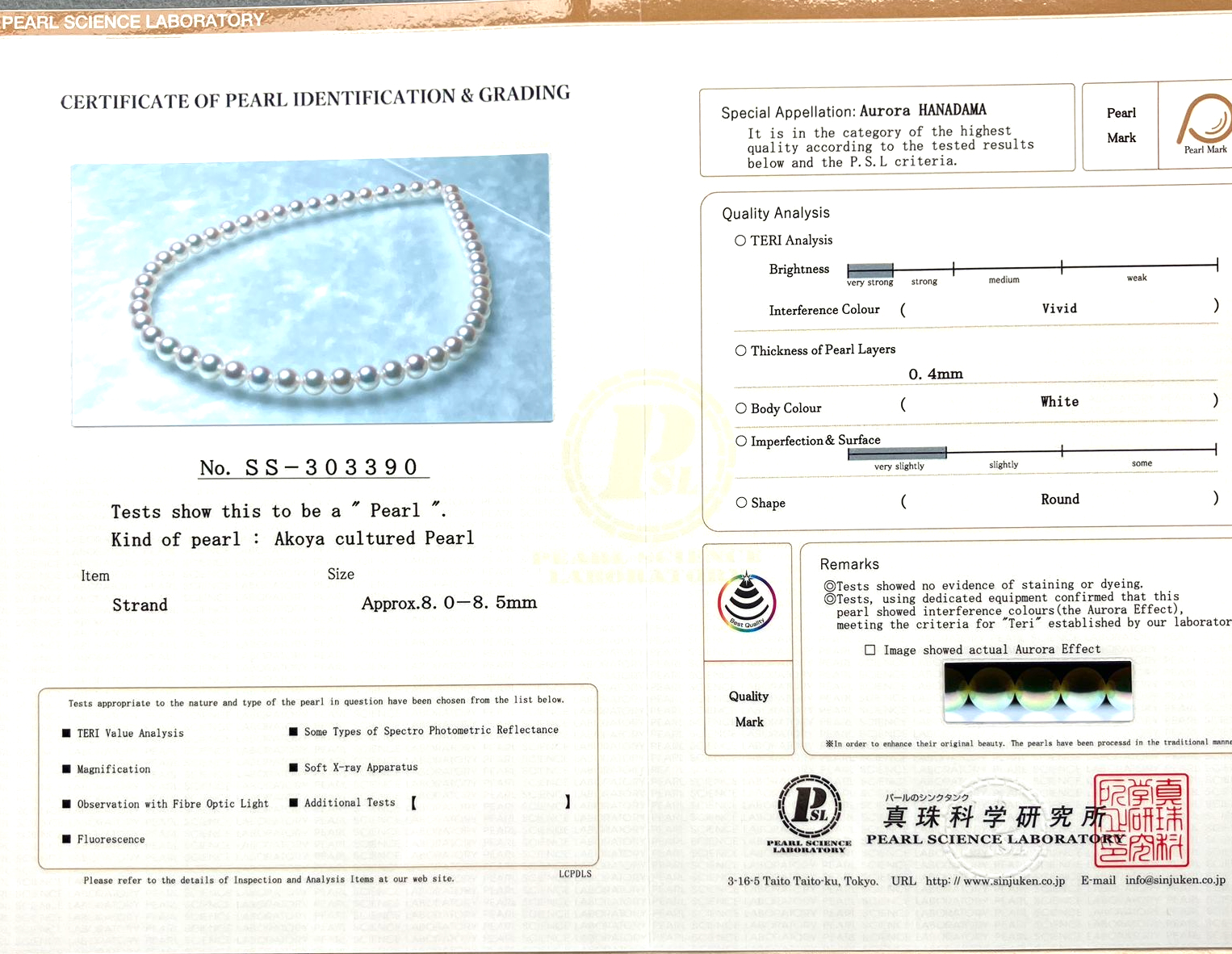
This is a real Pearl Science Laboratory (PSL) certificate for an Akoya strand we sell. Every box on it is a test result, not an opinion from the seller. Tap a number on the certificate to jump to what it means.
 1
2
3
4
5
6
7
8
9
10
11
1
2
3
4
5
6
7
8
9
10
11
Pearl Science Laboratory, Tokyo · Report No. SS-303390 · Tap the certificate to open it full size.
The certificate, box by box
The left half identifies the pearls and lists the tests used. The right half grades them.
1Title and report number
Every PSL report carries its own number, and it belongs to this strand and no other. The photograph above the number is of the actual strand that was tested, so the paper can't be moved from one necklace to another.
2What the pearls are
The first job of any lab report is identification. The tests confirm these are genuine pearls, not imitations, and that they are Akoya cultured pearls, grown in the Japanese Akoya oyster. The item is a full strand, and the pearls measure about 8.0 to 8.5 mm.
3The tests the laboratory used
- Teri value analysis. Teri is the Japanese word for a pearl's luster. PSL measures it with instruments rather than judging it by eye.
- Spectrophotometric reflectance. Measures how the surface reflects light across the color spectrum, which reveals the true body color and whether any color was added.
- Magnification. A close look at the surface and the drill holes for blemishes and the condition of the nacre.
- Soft X-ray. Looks inside the pearl to confirm how it was formed and to measure the thickness of the nacre around the bead.
- Fibre optic light. A bright, focused light shone through and across the pearl to show its inner structure and surface detail.
- Fluorescence. How the pearl glows under ultraviolet light, which helps confirm its origin and detect treatments.
4Special appellation and Pearl Mark
This box is the laboratory's own top designation. PSL awards it only when the test results on the right-hand side meet its criteria, which places the strand in its highest-quality category. The Pearl Mark beside it is the laboratory's seal for pearls that earn the appellation.
5Teri: brightness and interference color
Brightness is how sharply the pearl reflects light. This strand sits at the very top of PSL's four-step scale. Interference colour is the play of soft rainbow tones that comes from light bouncing between the thin layers of nacre. "Vivid" is the strongest result.
6Thickness of the pearl layers
Akoya pearls grow around a small bead, and the nacre is the layer the oyster builds over it. Thicker nacre gives deeper luster and wears better over a lifetime. This figure is measured by X-ray, not estimated. 0.4 mm is a thick coat for an Akoya pearl.
7Body color, surface and shape
Body colour is the pearl's main color: white. Imperfection & surface is on a three-step scale, and this strand is in the cleanest band, very slightly blemished. Shape is round, the most prized shape for a strand.
8Quality Mark
The round seal in this box is the laboratory's Best Quality mark, a quick visual sign of where the strand placed overall.
9Remarks: no dye, and the aurora effect
Two findings matter here. First, the tests found no staining or dyeing, so the color is the pearl's own. Second, PSL's dedicated equipment confirmed the aurora effect, the interference colors described in box 5, and that the pearls meet the laboratory's criteria for teri.
10The aurora photograph and the processing note
The strip of rainbow color is a photograph of this strand's own aurora effect, recorded by the lab. The small print below it notes that the pearls were processed in the traditional manner to bring out their natural beauty. That is the standard cleaning and finishing almost every white Akoya pearl receives after harvest. It is not a dye, which the remarks above rule out.
11The laboratory itself
The report is signed and sealed by Pearl Science Laboratory in Tokyo, an independent laboratory that specializes in pearls. Because it's an outside party, the grade on this certificate isn't ours. It's the laboratory's, and the report number ties it to this strand.
This report at a glance
| Factor | Result | What it tells you |
|---|---|---|
| Identification | Akoya cultured pearl | Genuine pearls from the Japanese Akoya oyster |
| Size | Approx. 8.0–8.5 mm | Pearl diameter across the strand |
| Brightness (teri) | Very strong | Top of the laboratory's four-step luster scale |
| Interference colour | Vivid | Strongest play of rainbow overtone |
| Nacre thickness | 0.4 mm | Measured by X-ray; thick for an Akoya pearl |
| Body colour | White | Natural white, with no dye found |
| Surface | Very slightly | Cleanest band of the laboratory's three-step scale |
| Shape | Round | The most prized shape for a strand |
| Treatment | No staining or dyeing | Standard traditional processing only |
Notice what isn't on the report: a percentage for surface. Even the laboratory describes surface in bands. The numbers it does give, such as nacre thickness, are ones its instruments actually measure. See a GIA report explained · How we grade our pearls.
See a certified strand for yourself
Our gemologists can walk you through any certificate, line by line. Call 1-800-847-3275 (international 212-764-1845), 10 a.m. to 5 p.m. Eastern, or email sales@americanpearl.com.