How to read a GIA pearl report
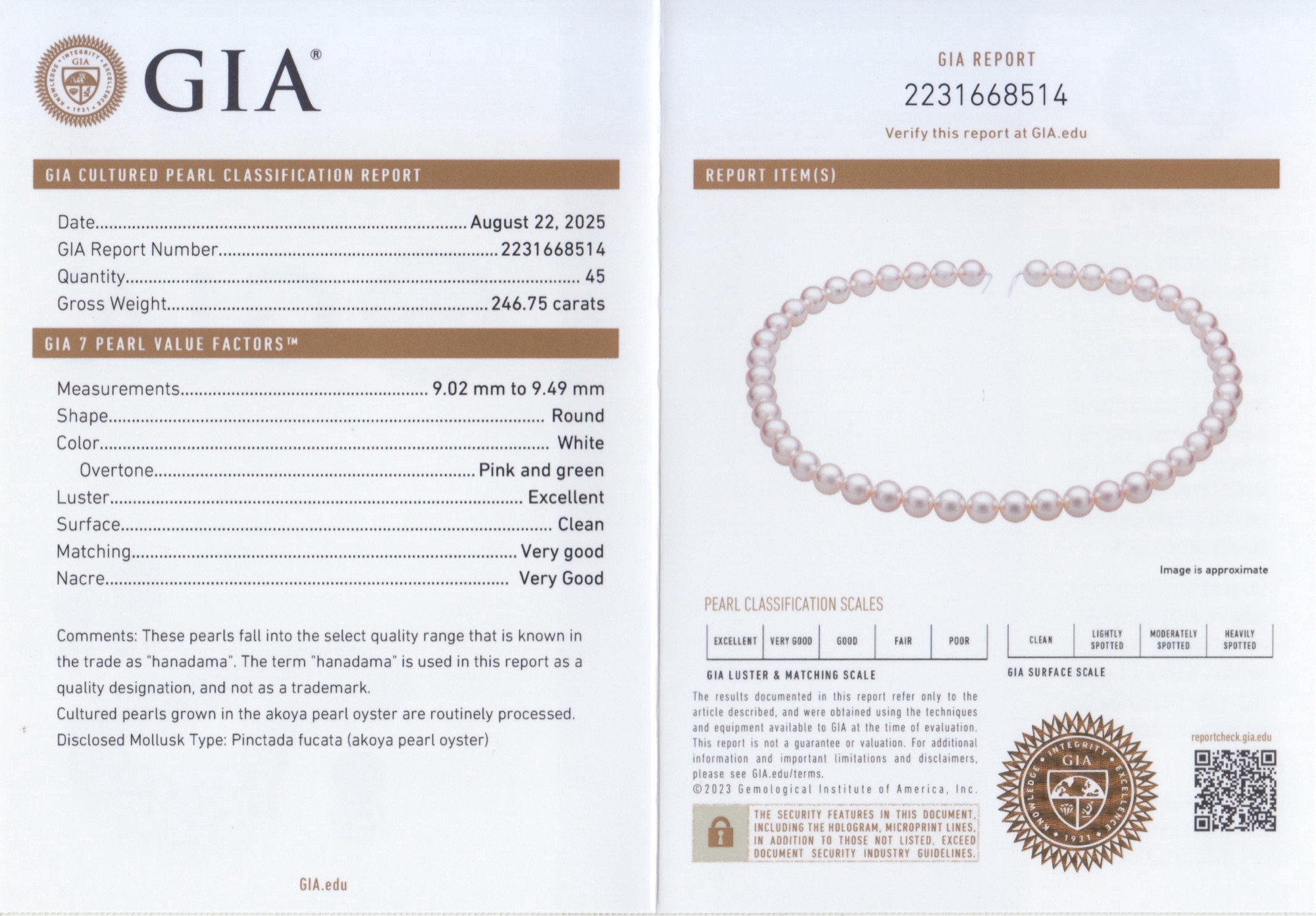
This is a real GIA Cultured Pearl Classification Report for a 9–9.5 mm Akoya strand we sell. GIA grades every pearl on the same seven value factors, and each line on the report is the laboratory's finding, not the seller's. Tap a number on the report to jump to what it means.
 1
2
3
4
5
6
7
8
9
10
11
12
13
1
2
3
4
5
6
7
8
9
10
11
12
13
GIA · Report No. 2231668514 · Tap the report to open it full size.
The report, line by line
The left page identifies the strand and grades it on GIA's 7 Pearl Value Factors™. The right page shows the strand itself, the grading scales and the security features.
1Report number and verification
Every GIA report has its own number, kept on file at GIA. Anyone can type it into GIA's Report Check at reportcheck.gia.edu and see the same results the laboratory recorded, so the paper can be checked against the source.
2Date, quantity and weight
The report counts the pearls on the strand, 45 here, and weighs them together. 246.75 carats is about 49 grams, or roughly 5.5 carats a pearl. Count and weight help tie the report to this exact strand.
3Size
GIA measures the smallest and largest pearls on the strand. 9 to 9.5 mm is near the top of the Akoya size range, since the Akoya oyster is small and rarely grows pearls over 10 mm.
4Shape
GIA sorts pearls into seven shape categories, from round to baroque. Round is the rarest and most prized shape for a strand, because the pearls roll and sit evenly and catch light the same way all around.
5Color and overtone
Color is the pearl's body color: white. Overtone is the translucent tint that seems to float over the surface. A pink overtone is the classic, most sought-after look in white Akoya, and the touch of green adds depth.
6Luster
Luster is how sharply the pearl reflects light. It's the factor most people notice first. Excellent is the top of GIA's five-step scale: reflections look bright and crisp.
7Surface
Surface describes small blemishes such as spots, bumps or wrinkles. Clean is the best of GIA's four bands. Like every lab, GIA describes surface in bands, not percentages.
8Matching
Matching grades how well the 45 pearls agree with each other in size, shape, color, luster and surface. Very good means the strand reads as one even necklace, with only slight differences between pearls.
9Nacre
Nacre is the layer the oyster builds around the bead. Thick nacre gives deep luster and wears well over a lifetime. GIA grades nacre on a five-step scale, from Excellent to Poor, and this strand is Very Good, the second step. The grade is a word, not a measurement in millimeters. That's one difference from a PSL report, which gives a measured thickness.
10Comments: hanadama, processing and mollusk
Hanadama is the trade name for the top quality range of Akoya pearls. GIA notes that this strand falls in that range, and is careful to say it uses the word as a quality designation, not a brand. The processing note is GIA's standard wording for Akoya: almost every white Akoya pearl is cleaned and finished after harvest. The mollusk line names the oyster the pearls grew in, Pinctada fucata, the Akoya pearl oyster.
11The strand itself
GIA photographs the actual strand it graded and prints the photo on the report. The picture lets you match the paper to the necklace. GIA notes that the image is approximate, because a printed photo can't reproduce luster or exact color.
12The grading scales
The report prints its own scales so you can see where each grade sits: five steps for luster and matching, four bands for surface. Shape and nacre have scales too, shown in boxes 4 and 9 above: seven shape categories and, since 2025, five nacre grades from Excellent to Poor. The small print says the results apply only to the item described and that the report is not a guarantee or a valuation. A GIA report grades a strand; it doesn't put a price on it.
13Security features and the GIA seal
GIA reports carry a hologram, microprint lines and other features that exceed document-security industry guidelines, which makes them hard to copy. The QR code opens GIA's Report Check, where the number on this report brings up the laboratory's own record. GIA is an independent, non-profit laboratory, so the grades on this report are GIA's, not ours.
This report at a glance
| Value factor | Result | What it tells you |
|---|---|---|
| Size | 9.02–9.49 mm | Near the top of the Akoya size range |
| Shape | Round | The most prized shape for a strand |
| Color | White, pink and green overtone | The classic white Akoya look |
| Luster | Excellent | Top of GIA's five-step scale |
| Surface | Clean | Best of GIA's four bands |
| Matching | Very good | Pearls agree closely across the strand |
| Nacre | Very Good | Thick, durable coating over the bead |
| Quality range | Hanadama | The trade's top quality range for Akoya |
GIA and Pearl Science Laboratory look at pearls differently. GIA grades all seven value factors in words; PSL measures luster and nacre thickness with instruments. That's why we offer both GIA-certified strands and PSL-certified strands, so you can choose the report you prefer. See a PSL report explained · How we grade our pearls.
See the strand on this report
This report belongs to our 9–9.5 mm GIA-certified Akoya strand. Our gemologists can walk you through any certificate, line by line. Call 1-800-847-3275 (international 212-764-1845), 10 a.m. to 5 p.m. Eastern, or email sales@americanpearl.com.