
Learn How To Identify Akoya Pearl Quality
When shopping for pearls, you will quickly notice that Akoya pearls and other coveted pearl types vary widely in price. You can pay a difference of several thousand dollars for a pearl necklace depending on the type of pearl and its natural characteristics, like size, color and luster. Thus, it's extremely important that you ask yourself what you want out of your pearl before you make your purchase. If you're looking for an investment-grade cultured Japanese pearl that will surely become an heirloom, you'll want to know a little bit more about Akoya pearl grades before making your decision to ensure that yours is of AAA quality.
Understanding How to Grade Akoya Pearls: Value and Quality
We are assuming that you are looking to purchase a strand of Japanese Akoya cultured pearls, the same finer-quality pearls one would find at an upscale jewelry store such as Mikimoto or Tiffany & Co. We say Tiffany & Co. or Mikimoto because it is at these two stores in the marketplace that one could find our superior quality pearls. It is for this category of pearls that we are going to continue this pearl education. Please make a special note that American Pearl sells perfectly round, perfectly clean pearls in our true AAA grade. This is the same quality standard adhered to at Mikimoto in their true AAA label.
Because American Pearl offers you perfectly clean pearls in the true AAA grade, you can rest assured that your pearls will hold their value and appreciate in value over time, whereas a strand of blemished pearls diminish in value over time. You can also learn the verbal descriptions of the grades/labels (such as true AAA) and how to identify good pearls, thereby empowering you to link pearl quality to market value for yourself. Akoya pearl value is not determined by the brand or the retailer, but instead by its natural qualities, as explained below.
Why Pearls Are Valuable
Throughout history, pearls have shown themselves in practically every civilization and culture imaginable. From ancient Egypt to Mesopotamia, the unmistakable presence of pearls is difficult to deny. In these early days, where much upon the earth was still undiscovered, the sheer beauty, brilliance and awe of the first pearl ever discovered surely differentiated itself from anything else. Perhaps it was the pearl's beauty that first enamored these ancient societies. Or could it be the pearls' mystical qualities that caused people who owned them to associate similar feelings about themselves? Of course, with this beauty came an increased demand for something that was still unknown. In fact, the harder they tried to find pearls, the more difficult it was to find them. Within this first cycle of discovery, awe and the need to have more, the ancients unknowingly created a process that would give birth to one of the most valuable gems in the world: pearls.
Making the Wisest Akoya Pearl Purchase
The very fact that it was the beauty of the first pearl ever discovered that defined the pearl's value as a gem is critical in your purchasing process. When purchasing pearls or any other jewelry, it is your responsibility as a consumer to purchase the finest-quality, most beautiful pearls in your price range. There are several reasons for this. Because finer quality pearls are more beautiful, they will be enjoyed more. Finer-quality pearls have the best chance of holding their value and improving in value over time as they have more of the characteristics that make them valuable. In addition, finer pearls must have a thicker nacre (the skin of the pearl) in order to deliver more luster (the mirror-like quality of a pearl), making them more durable and heavier. In fact, nacre thickness and luster are often directly correlated.
Our Commitment to Quality
Regardless of what strand of pearls or pearl jewelry you purchase from American Pearl, rest assured that all the pearls on the strand will be perfectly round. As you go up in quality, the pearls' luster and nacre thickness increases.
Assure Your Purchase Using the GIA Pearl Grading System
If you are looking for a strand of Japanese Akoya cultured pearls, what follows is a grading system based on the Gemological Institute of America (GIA) Pearl Grading System. American Pearl has assembled a master set of pearls that meet all the characteristics that complement the GIA pearl grading system.
The GIA is the unmistakable sole authority that is recognized and respected by finer jewelry establishments. No other organization is more reputable and trustworthy. In fact, the GIA is the only gemological institute recognized by Tiffany & Co., with good reason. The GIA has pioneered and established the nomenclature for grading and assessing cultured pearls in America. It is their grading system and classes which have educated jewelers across America. Because we also use this system, if you buy a pearl necklace, Tiffany or Mikimoto will offer the same quality as a necklace purchased at American Pearl.
This grading system describes pearls based on an array of characteristics listed below. Once you understand how to judge a strand of pearls based on these grading categories, you will be able to link pearl quality to market value. In essence, you will understand the verbal descriptions for each grading category so you can understand what a label/grade (such as true AAA, AA, A+ and A) means. Please note, there are other varieties of pearls, such as South Sea pearls, for which we discuss quality.
Measurement
The measurement indicates the pearl size of a single pearl or the range of pearl sizes on a pearl necklace. Each strand (pearl necklace) of cultured pearls or natural pearls can have a range of graduation from the typical smaller pearls on the end a pearl necklace to the larger pearls in the center of the necklace. For example, a pearl necklace can range from 7.5mm on either end to 8mm in the center of the necklace resulting in a description that is "Ranging from 8.00 mm to 7.50mm".
Drilling
Pearls that are strung on a necklace must be drilled, thereby giving the description of "drilled" under the drilling description category.
Pearls
Pearls are either going to be graded as cultured pearls or natural pearls. According to the G I A , cultured pearls are nacreous formations secreted in the interior productive mollusks following human intervention. Natural pearls are formations secreted accidentally in the interior of a variety of seawater and freshwater mollusks without the aid of any human agency.
Environment
Pearls will be graded either saltwater or freshwater.
Mollusk
An invertebrate of a large phylum (Mollusca) that produced the pearl reported under identification.
Treatments
Pearls can be untreated or treated.
Shape
Shape is important in judging pearls. The rounder a pearl is, the higher its value. Baroque pearls have irregular, distorted shapes. If you purchase a strand of cultured pearls from American Pearl, you can rest assured that your pearls will be perfectly round unless otherwise mentioned.
Round - No variations are apparent to the unaided eye.
Near Round - Slightly elongated or flattened. Only minor variations are apparent to the unaided eye.
Oval - Appear symmetrical, rounded and oblong.
Button - Appear symmetrical, rounded and flattened.
Drop - Appear symmetrical, rounded and pear shaped.
Semi-Baroque - Appear not quite symmetrical; off-round and/or slightly irregular drop, button or oval shaped.
Baroque - Appear to have no apparent symmetry; irregular in shape.
Other - Any non-standard shape such as a bar or cross.
Circled - One or more grooved or ridged rings around the circumference of any shape of pearl. If the grooves extend around the entire circumference of the pearl, it is described as a circled pearl. The shape category and the circled modifier is used as a descriptor. For example: "Circled Oval."
Body Color
Body color is the basic color of a pearl. The most common body colors are white and cream. White and pink command the highest value. The vast majority of consumers who purchase pearls with American Pearl, Mikimoto or Tiffany & Co. select a white body color pearl. White Akoya Pearls are routinely bleached in order to produce a white pearl.
The overall color of a pearl is called body color. The body color can have individual overlying translucent color(s) called overtone. Multiple overlying colors or surface iridescence is called orient, which can be present as well.

Overtone
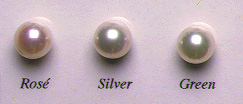
Overtone(s) are the colors that complement the body color. Pearls with rosé or silver overtones have the highest value. People often ask us how to choose between rosé overtone pearls and silver overtone pearls. A consumer shopping for a Mikimoto or Tiffany & Co. pearl necklace will find that these jewelers are known for selling rosé overtones. According to the GIA (Gemological Institute of America), rosé overtones and silver overtones improve the value of white pearls. Remember too, pearls absorb the surrounding colors due to their reflective nature. Ultimately, once draped around the necklace, it is honestly difficult to notice the difference between rosé or silver overtones as it is very subtle. One should always purchase the color that they are drawn to.
Luster
Luster is the intensity (quantity and quality) of light reflected from the surface of a pearl. High-luster pearls also have a deep-seated glow. The luster of a good quality pearl should be bright and not dull. You should be able to see your own reflection clearly on the surface of a very high luster pearl. Reflected images of overhead lights are crisp and distinct in higher luster pearls while they are smudgy and washed-out in dull ones. Any pearl that appears too white, dull or chalky indicates low luster. Higher-luster pearls are most valuable.
Below are the range of grades for luster:
Excellent - Reflections appear bright and sharp.
Very Good - Reflections appear bright and near sharp.
Good - Reflections appear bright but not sharp.
Fair - Reflections are weak and blurred.
Poor - Reflections are dim and diffused.
If you walk into a Mikimoto store, their true AAA Quality is Excellent Luster, their AA quality is Very Good, their A+ quality is Good Luster and their A quality is Fair Luster. True AAA Quality has the highest attainable luster.
Surface
There are many types of characteristics and irregularities, usually confined to the pearl's surface. These can affect appearance and durability.
Clean - Pearls might have minute surface characteristics that are difficult to see.
Lightly Spotted - Pearls have minor surface irregularities visible.
Moderately Spotted - Have noticeable surface characteristics.
Heavily Spotted - Have obvious surface irregularities that might affect durability.
Matching
Matching describes the uniformity of pearls in jewelry. It is judged by consistency of size, shape, color, luster, surface quality and nacre quality. For pearls that are intentionally mismatched, harmonious design and balanced effect are also considered applicable factors.
Excellent - Most to all pearls have a uniform appearance and are drilled on-center.
Very Good - Most to all pearls have only very minor variations in uniformity.
Good - Most to all pearls have only minor variations in uniformity.
Fair - Most to all pearls have noticeable variations in uniformity.
Poor - Most to all pearls have very noticeable variations in uniformity.
Why are Japanese Akoya pearls the highest luster pearls in the world? Because Japanese pearls grow in waters whose colder temperatures affect the crystal structure of the nacre (the material of which pearls are made of) and make it potentially more lustrous than the nacre of cultured pearls grown elsewhere.
Do higher luster pearls have a longer life?
Yes. High luster is an indicator of good nacre thickness and, as such, is an assurance of durability. The thicker the nacre coating on a pearl, the longer it will last.

When shopping for pearls, you will quickly notice that Akoya pearls and other coveted pearl types vary widely in price. You can pay a difference of several thousand dollars for a pearl necklace depending on the type of pearl and its natural characteristics, like size, color and luster. Thus, it's extremely important that you ask yourself what you want out of your pearl before you make your purchase. If you're looking for an investment-grade cultured Japanese pearl that will surely become an heirloom, you'll want to know a little bit more about Akoya pearl grades before making your decision to ensure that yours is of AAA quality.
Understanding How to Grade Akoya Pearls: Value and Quality
We are assuming that you are looking to purchase a strand of Japanese Akoya cultured pearls, the same finer-quality pearls one would find at an upscale jewelry store such as Mikimoto or Tiffany & Co. We say Tiffany & Co. or Mikimoto because it is at these two stores in the marketplace that one could find our superior quality pearls. It is for this category of pearls that we are going to continue this pearl education. Please make a special note that American Pearl sells perfectly round, perfectly clean pearls in our true AAA grade. This is the same quality standard adhered to at Mikimoto in their true AAA label.
Because American Pearl offers you perfectly clean pearls in the true AAA grade, you can rest assured that your pearls will hold their value and appreciate in value over time, whereas a strand of blemished pearls diminish in value over time. You can also learn the verbal descriptions of the grades/labels (such as true AAA) and how to identify good pearls, thereby empowering you to link pearl quality to market value for yourself. Akoya pearl value is not determined by the brand or the retailer, but instead by its natural qualities, as explained below.
Why Pearls Are Valuable
Throughout history, pearls have shown themselves in practically every civilization and culture imaginable. From ancient Egypt to Mesopotamia, the unmistakable presence of pearls is difficult to deny. In these early days, where much upon the earth was still undiscovered, the sheer beauty, brilliance and awe of the first pearl ever discovered surely differentiated itself from anything else. Perhaps it was the pearl's beauty that first enamored these ancient societies. Or could it be the pearls' mystical qualities that caused people who owned them to associate similar feelings about themselves? Of course, with this beauty came an increased demand for something that was still unknown. In fact, the harder they tried to find pearls, the more difficult it was to find them. Within this first cycle of discovery, awe and the need to have more, the ancients unknowingly created a process that would give birth to one of the most valuable gems in the world: pearls.
Making the Wisest Akoya Pearl Purchase
The very fact that it was the beauty of the first pearl ever discovered that defined the pearl's value as a gem is critical in your purchasing process. When purchasing pearls or any other jewelry, it is your responsibility as a consumer to purchase the finest-quality, most beautiful pearls in your price range. There are several reasons for this. Because finer quality pearls are more beautiful, they will be enjoyed more. Finer-quality pearls have the best chance of holding their value and improving in value over time as they have more of the characteristics that make them valuable. In addition, finer pearls must have a thicker nacre (the skin of the pearl) in order to deliver more luster (the mirror-like quality of a pearl), making them more durable and heavier. In fact, nacre thickness and luster are often directly correlated.
Our Commitment to Quality
Regardless of what strand of pearls or pearl jewelry you purchase from American Pearl, rest assured that all the pearls on the strand will be perfectly round. As you go up in quality, the pearls' luster and nacre thickness increases.
Assure Your Purchase Using the GIA Pearl Grading System
If you are looking for a strand of Japanese Akoya cultured pearls, what follows is a grading system based on the Gemological Institute of America (GIA) Pearl Grading System. American Pearl has assembled a master set of pearls that meet all the characteristics that complement the GIA pearl grading system.
The GIA is the unmistakable sole authority that is recognized and respected by finer jewelry establishments. No other organization is more reputable and trustworthy. In fact, the GIA is the only gemological institute recognized by Tiffany & Co., with good reason. The GIA has pioneered and established the nomenclature for grading and assessing cultured pearls in America. It is their grading system and classes which have educated jewelers across America. Because we also use this system, if you buy a pearl necklace, Tiffany or Mikimoto will offer the same quality as a necklace purchased at American Pearl.
This grading system describes pearls based on an array of characteristics listed below. Once you understand how to judge a strand of pearls based on these grading categories, you will be able to link pearl quality to market value. In essence, you will understand the verbal descriptions for each grading category so you can understand what a label/grade (such as true AAA, AA, A+ and A) means. Please note, there are other varieties of pearls, such as South Sea pearls, for which we discuss quality.
Measurement
The measurement indicates the pearl size of a single pearl or the range of pearl sizes on a pearl necklace. Each strand (pearl necklace) of cultured pearls or natural pearls can have a range of graduation from the typical smaller pearls on the end a pearl necklace to the larger pearls in the center of the necklace. For example, a pearl necklace can range from 7.5mm on either end to 8mm in the center of the necklace resulting in a description that is "Ranging from 8.00 mm to 7.50mm".
Drilling
Pearls that are strung on a necklace must be drilled, thereby giving the description of "drilled" under the drilling description category.
Pearls
Pearls are either going to be graded as cultured pearls or natural pearls. According to the G I A , cultured pearls are nacreous formations secreted in the interior productive mollusks following human intervention. Natural pearls are formations secreted accidentally in the interior of a variety of seawater and freshwater mollusks without the aid of any human agency.
Environment
Pearls will be graded either saltwater or freshwater.
Mollusk
An invertebrate of a large phylum (Mollusca) that produced the pearl reported under identification.
Treatments
Pearls can be untreated or treated.
Shape
Shape is important in judging pearls. The rounder a pearl is, the higher its value. Baroque pearls have irregular, distorted shapes. If you purchase a strand of cultured pearls from American Pearl, you can rest assured that your pearls will be perfectly round unless otherwise mentioned.
Round - No variations are apparent to the unaided eye.
Near Round - Slightly elongated or flattened. Only minor variations are apparent to the unaided eye.
Oval - Appear symmetrical, rounded and oblong.
Button - Appear symmetrical, rounded and flattened.
Drop - Appear symmetrical, rounded and pear shaped.
Semi-Baroque - Appear not quite symmetrical; off-round and/or slightly irregular drop, button or oval shaped.
Baroque - Appear to have no apparent symmetry; irregular in shape.
Other - Any non-standard shape such as a bar or cross.
Circled - One or more grooved or ridged rings around the circumference of any shape of pearl. If the grooves extend around the entire circumference of the pearl, it is described as a circled pearl. The shape category and the circled modifier is used as a descriptor. For example: "Circled Oval."
Body Color
Body color is the basic color of a pearl. The most common body colors are white and cream. White and pink command the highest value. The vast majority of consumers who purchase pearls with American Pearl, Mikimoto or Tiffany & Co. select a white body color pearl. White Akoya Pearls are routinely bleached in order to produce a white pearl.
The overall color of a pearl is called body color. The body color can have individual overlying translucent color(s) called overtone. Multiple overlying colors or surface iridescence is called orient, which can be present as well.
Overtone
Overtone(s) are the colors that complement the body color. Pearls with rosé or silver overtones have the highest value. People often ask us how to choose between rosé overtone pearls and silver overtone pearls. A consumer shopping for a Mikimoto or Tiffany & Co. pearl necklace will find that these jewelers are known for selling rosé overtones. According to the GIA (Gemological Institute of America), rosé overtones and silver overtones improve the value of white pearls. Remember too, pearls absorb the surrounding colors due to their reflective nature. Ultimately, once draped around the necklace, it is honestly difficult to notice the difference between rosé or silver overtones as it is very subtle. One should always purchase the color that they are drawn to.
Luster
Luster is the intensity (quantity and quality) of light reflected from the surface of a pearl. High-luster pearls also have a deep-seated glow. The luster of a good quality pearl should be bright and not dull. You should be able to see your own reflection clearly on the surface of a very high luster pearl. Reflected images of overhead lights are crisp and distinct in higher luster pearls while they are smudgy and washed-out in dull ones. Any pearl that appears too white, dull or chalky indicates low luster. Higher-luster pearls are most valuable.
Below are the range of grades for luster:
Excellent - Reflections appear bright and sharp.
Very Good - Reflections appear bright and near sharp.
Good - Reflections appear bright but not sharp.
Fair - Reflections are weak and blurred.
Poor - Reflections are dim and diffused.
If you walk into a Mikimoto store, their true AAA Quality is Excellent Luster, their AA quality is Very Good, their A+ quality is Good Luster and their A quality is Fair Luster. True AAA Quality has the highest attainable luster.
Surface
There are many types of characteristics and irregularities, usually confined to the pearl's surface. These can affect appearance and durability.
Clean - Pearls might have minute surface characteristics that are difficult to see.
Lightly Spotted - Pearls have minor surface irregularities visible.
Moderately Spotted - Have noticeable surface characteristics.
Heavily Spotted - Have obvious surface irregularities that might affect durability.
Matching
Matching describes the uniformity of pearls in jewelry. It is judged by consistency of size, shape, color, luster, surface quality and nacre quality. For pearls that are intentionally mismatched, harmonious design and balanced effect are also considered applicable factors.
Excellent - Most to all pearls have a uniform appearance and are drilled on-center.
Very Good - Most to all pearls have only very minor variations in uniformity.
Good - Most to all pearls have only minor variations in uniformity.
Fair - Most to all pearls have noticeable variations in uniformity.
Poor - Most to all pearls have very noticeable variations in uniformity.
Why are Japanese Akoya pearls the highest luster pearls in the world? Because Japanese pearls grow in waters whose colder temperatures affect the crystal structure of the nacre (the material of which pearls are made of) and make it potentially more lustrous than the nacre of cultured pearls grown elsewhere.
Do higher luster pearls have a longer life?
Yes. High luster is an indicator of good nacre thickness and, as such, is an assurance of durability. The thicker the nacre coating on a pearl, the longer it will last.